
Chances are, you’ve parked yourself in front of the TV to “watch just one episode.” Or you’ve jumped on your computer for “one quick round” of Call of Duty. Or maybe you’ve opened TikTok for a quick scroll around the block and… well, you know how that story ends.
These little binges—they’re fun, they’re easy, and they feel good, don’t they? But there’s a flip side to them. That nagging sense that your brain’s turned into mush.
There’s a term for it—and one that snagged the title of Oxford’s Word of the Year for 2024. It’s called “brain rot.”
What is brain rot?
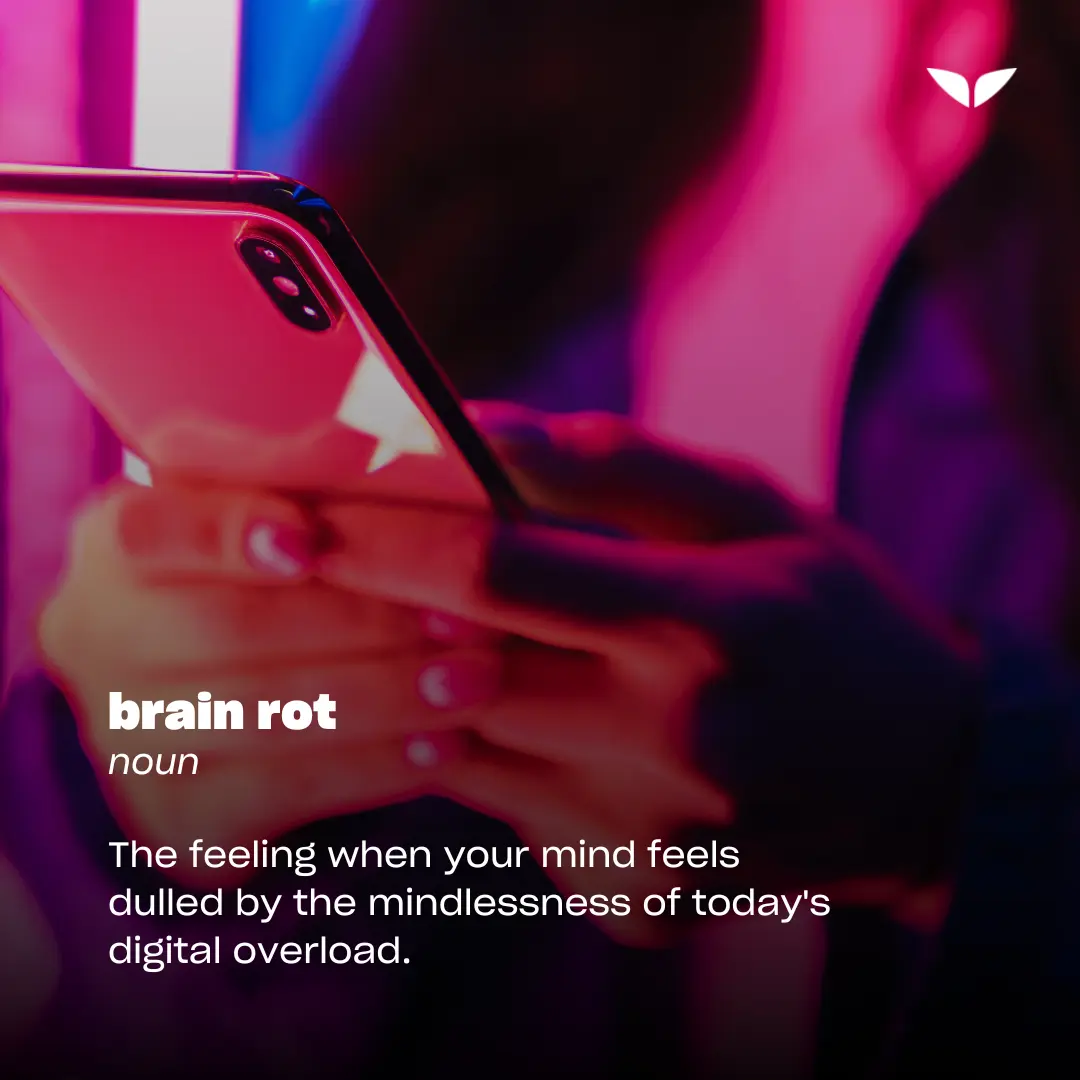
The meaning of brain rot is simply this: that all-too-familiar feeling when your mind seems dulled by the mindlessness that our digital diets have allowed us in this day and age. It’s not a new term but one that dates back to 1854, when Henry David Thoreau used it in his book Walden, to call out society’s intellectual laziness.
Comparing it to the potato blight that was devastating Ireland at the time, the philosopher commented, “While England endeavors to cure the potato rot, will not any endeavor to cure the brain-rot—which prevails so much more widely and fatally?”
For him, the culprit was shallow thinking and an obsession with trivialities. And it’s a problem that’s only evolved over generations.
“Our world has always been full of things designed to distract us,” says Nir Eyal, the author of Indistractable, in his Becoming Focused and Indistractable Quest on Mindvalley.
While dime novels with sensational plots were to blame in Henry’s time, for Baby Boomers, it was the hypnotic lure of TV sitcoms. Gen X had MTV. Millennials with their MySpace pages and Facebook. And Gen Z and Gen Alpha? Well, we all have social media and low-effort content to thank for the hours of their dopamine-fueled overstimulation.
“At least,” Nir adds, “we can take some comfort in knowing that distraction is not a new phenomenon.”
Given that every generation has its own version of “brain rot,” it’s not surprising that adults in the U.S., on average, are spending anywhere from seven to eight hours daily on screens. That’s talking about now—in 2024.
No wonder Oxford gave it a crown. The title of Word of the Year perfectly sums up our growing love-hate relationship with the digital distractions that turn our brains into a muddle.
What causes it?
Endless TikTok dances or doomscrolling aren’t the sole villains when it comes to answering the query, “What causes brain rot?” According to Nir, our noggins are wired for distraction, and three sneaky characteristics make it ridiculously easy for us to veer off track.
First, there’s present bias, which psychologists call hyperbolic discounting. It may sound fancy but it really just means that we tend to prioritize instant gratification over long-term goals. (Great for surviving in the wild; not so helpful when you’re bingeing snacks and skipping workouts.)
Then, there’s marginal thinking, which makes us the human equivalent of squirrels with unlimited Wi-Fi. We’re constantly hopping from one thing to the next—email to TikTok, TikTok to Slack—always chasing the juiciest distraction.
And finally, we’re creatures of habit, and, unfortunately, it’s not always the good kind. Nir explains that when the brain learns a pattern, “it drives an impulse for us to repeat that behavior again and again.”
In fact, about 40% of our daily behaviors are habits we don’t even think about. Pick up your phone during an awkward pause? That’s habit. Open Instagram before you’ve even had coffee? Habit.
These routines, once formed, are tough to shake, even when you know they’re sabotaging your best-laid plans. But understanding these tendencies is step one in “unrotting” your brain.
Is brain rot a real thing?
The term doesn’t mean your brain is actually decaying—it’s not as if your neurons are throwing in the towel because you spent an hour watching cat videos. But the feeling it describes? That sluggish, can’t-string-a-thought-together, why-can’t-I focus haze? Oh, that’s real.
Distraction is just another way of our brain attempting to deal with discomfort.
— Nir Eyal, trainer of Mindvalley’s Becoming Focused and Indistractable Quest
But the question is, how does the brain get here?
For one, research on adolescents with Internet addiction found lower gray matter density in the brain—essentially, the areas responsible for focus, decision-making, and impulse control. These changes are incredibly similar to those seen in substance addiction, which may explain why “just one more episode” can so easily spiral into an all-night Netflix marathon.
On top of that, there’s cognitive overload, when your brain is bombarded with trivial information like endless memes, TikTok trends, or the 47th “breaking news” alert of the day. This overwhelms your working memory and makes it harder to focus on meaningful tasks, retain information, or even have a coherent thought.
And let’s not forget the toll it can have on mental health. All this screen time is linked to higher rates of anxiety and depression, creating a vicious cycle. The more overwhelmed you feel, the more likely you are to reach for easy, dopamine-hit distractions.
The irony, as Nir points out, is that the constant pull of today’s 24-hour content isn’t about enjoyment. “We don’t even have to like something or someone to want it or them,” he says. But it’s the promise of temporary escape from boredom, stress, or even the smallest twinge of unease that keeps us reaching for our devices and sinking deeper into brain rot.
How to stop brain rot, according to Mindvalley experts
For real, nobody wants a brain that feels like it’s running on dial-up. But if endless doom scrolling and constant distractions have taken up permanent residence in your mental space, it’s time for a bit of spring cleaning.
The trick isn’t ditching your phone or swearing off social media forever (because, let’s face it, that’s not happening). It’s about figuring out how to give your brain a breather and learn how to not get distracted so your mind feels like yours again.
And yes, it’s totally doable—here’s how:
1. Embrace your “discomfort”
“Distraction,” says Nir, “is just another way of our brain attempting to deal with discomfort.”
But in (probably) the safest, healthiest, well-educated, most democratic time in history, what discomfort could there be?
Nir goes on to explain that some part of the human psyche causes us to “constantly seek out escape from things stirring inside us.” Boredom, negativity, or that restless itch for something more—these internal triggers are the brain’s default state.
And the kicker is, that’s not a problem to solve; it’s a reality to accept. As Nir points out, it’s a human feature that “propels us to do everything we do, including to hunt, to seek, to create, and to adapt.”
So instead of trying to dodge these feelings, notice them. Ask yourself, “What am I really trying to escape?”
The goal here isn’t to eliminate discomfort but to recognize it for what it is—fuel for meaningful action.
2. Understand what you’re distracted from
“You can’t call something a distraction unless you know what it distracted you from,” Nir points out. And that’s the crux of it.
The thing is, distractions thrive in the absence of clarity. If you don’t know what you want to spend your time on, it’s all too easy to fill the void with mindless scrolling, trivial tasks, or even revenge bedtime procrastination.
Nir’s advice is to define your priorities and align them with your values. Consider what truly matters to you—being more present for your family, prioritizing your health, or excelling in your career. Then, make the time to actually do these things.
“If we chronically neglect our values, we become someone we’re not proud of,” Nir explains. “Ironically, this ugly feeling makes us more likely to seek distraction to escape our dissatisfaction without actually solving the problem.”
When you understand what you’re distracted from, you can stop wasting mental energy on things that don’t serve you and start investing it in what does.
3. Hack your digital habits
Social media, news feeds, and recommendation algorithms aren’t inherently evil. However, they are designed to keep us hooked.
But, as Nir emphasizes, just because these platforms leverage “sophisticated neuroscience to keep us clicking” ‘til our brains mush out, it doesn’t mean we can’t “hack back.”
Here’s what he suggests doing:
- Clean up your feeds with tools like News Feed Eradicator or DF Tube. This ensures you only see what you intended to check without falling into a rabbit hole.
- Decide where you want to go instead of letting algorithms decide for you. Want to check a friend’s post? Visit their page directly. Have a work message to respond to? Bookmark the messaging page instead of the main feed.
- Use apps to strip away unnecessary distractions. For instance, save articles to read later using apps like Pocket. (Pro tip: pair it with activities like walking or exercising to multitask productively so you can turn a potentially distracting activity into a reward for doing something healthy or meaningful.)
These hacks don’t require a complete digital detox. Rather, they allow you to use technology on your terms instead of letting it use you. And by doing so, you can regain mental clarity and make room for deeper, more intentional engagement.
4. Mind how you talk to yourself
“Your brain is like a supercomputer, and your self-talk is the program it will run,” says Jim Kwik, a brain performance coach and trainer of Mindvalley’s Superbrain Quest. In other words, if you’re constantly muttering things like “I can’t focus” or “I’m not good enough,” you’re basically handing your brain a sticky note that says, “Please malfunction.”
Over time, this unchecked negative chatter contributes to mental stagnation. That, in turn, can drain your intellectual energy and leave you vulnerable to pointless distractions. As Jim points out, when you “argue for your limitations,” you “get to keep them.”
To counter that, he suggests the ABRA technique:
- Acknowledge. Don’t fight the negative thought. Simply recognize it.
- Breathe. Take a deep breath, imagining yourself inhaling potential and exhaling…well, nonsense.
- Release. Exhale and picture letting the thought go.
- Align. Replace it with its positive opposite, like “I’ve got this” or “I can stay focused.”
This little exercise might sound small, but it’s like rebooting your mental operating system. And when you do so, you’re clearing space for sharper thinking and meaningful focus.
5. Surround yourself with high-quality people
“Who you spend time with is who you become,” Jim says. So if you’re constantly surrounded by negativity—whether it’s critical friends, doubting colleagues, or social media echo chambers—it’s easy to absorb those influences. Over time, this can erode your mental sharpness, leaving you stuck in a loop of superficial content and shallow thinking.
That’s why Jim emphasizes being intentional about your external environment. Spend time with people who challenge and uplift you, who stimulate you intellectually and inspire you, who help you increase your brain power rather than slipping into mental stagnation.
These are the people who encourage your growth and push you toward meaningful goals… and a more meaningful life.
BONUS: Prioritize your brain in the morning
If your brain’s going to thrive, it needs a good start. And Jim’s all about setting the tone for your day: “Design the first hour a day to be brain-friendly and you’ll win the rest of the day.”
Here’s his morning routine you can try:
- Hydrate like it’s your job. Your brain is 80% water, so first thing, drink up. No coffee yet—just pure, unadulterated H2O.
- Move your body. Whether it’s a few minutes of high-intensity exercise or just brushing your teeth with the opposite hand (yes, really), movement gets blood—and oxygen—to your brain.
- Feed your brain. Smoothies with power foods or tea packed with brain-boosting herbs can fuel focus and memory.
- Write it down. Gratitude journaling isn’t just about warm fuzzies. It’s been linked to better mental health and clarity, which means fewer excuses to doom scroll later.
- Read. Even just 20 minutes a day keeps your brain sharp and gives you something more interesting to think about than whatever’s trending online.
The magic here isn’t in any one habit—it’s in combining them. As Jim says, “First you make your habits, then your habits make you.”
Give your brain the VIP treatment in the morning, and you’ll fend off brain rot before it even has a chance to creep in.
Reclaim your mental edge
Your brain deserves better than “just one episode” turning into an all-night binge, or a “quick scroll” spiraling into a full-blown deep dive into “Pedro, Pedro, Pedro” memes at 2 a.m. But “brain rot” didn’t snag Oxford’s Word of the Year for nothing.
If distraction’s your nemesis, Nir Eyal’s Quest, Becoming Focused and Indistractable, will help you wrangle your attention span and reclaim your time.
But if it’s brain fog and forgetfulness you’re fighting? Jim Kwik’s free Becoming a Superlearner Masterclass is your mental upgrade.
With him as your guide, you’ll learn brain hacks that sound almost too good to be true—like boosting focus with a handful of the right foods, brushing your teeth to build neural connections (yes, really), and creating a morning routine that sets you up for mental domination. You’ll even figure out how to stop saying “I forgot…” for good.
Over 3 million students have been on the ride, including Goldy, a consultant in Uganda, whose struggle with brain fog, forgetfulness, and mental fatigue left her overwhelmed and anxious. After learning Jim’s techniques, she not only turned things around but also nailed her role as a keynote speaker at the Mental Health 2024 Summit.
So why not join her and the others and start your brain’s comeback story?
Welcome in.
https://blog.mindvalley.com/brain-rot/
#manifest #lawofattraction #manifestation #love #selflove #meditation #abundance #believe #spirituality #spiritualawakening #energy #spiritual #positivevibes #healing #motivation #loa #manifesting #awakening #universe #positivity #inspiration #gratitude #affirmations #consciousness #mindfulness #selfcare #lightworker #success #thesecret #bhfyp